

Modern B2B buyers have zero patience for the traditional corporate waiting game. Practice has shown that over 70% of businesses award their contract to the vendor that responds first, turning inbound sales into a pure race against time.
Despite this, the average corporate response time for an inbound inquiry remains in the ballpark of 40+ hours by most estimates.
This delay persists because traditional systems treat inbound data as a passive storage problem. When a prospect submits a high-intent request on a website, the information hits the CRM, flashes a notification to a routing queue, and then stops.
A representative must manually review the submission, cross-reference their calendar, check account histories, and draft a response from scratch.
By the time this manual loop concludes, hours or days have elapsed, allowing prime buyer intent to evaporate before an organization ever initiates contact.
Data-driven revenue operations are breaking this bottleneck by moving from passive storage to immediate, programmatic activation.
By embedding an AI agent that plugs into tools like Salesforce and HubSpot, companies are moving inbound conversations forward in seconds rather than days.
How Manual Gating Disrupts Inbound Conversion?
Relying on human triage to manage sudden spikes in inbound volume introduces distinct structural points of failure for a growing pipeline:
- The Inbound Decay Curve: High-intent interest cools rapidly. A buyer requesting a live environment walkthrough or pricing details wants to resolve a current problem right then and there. A multi-hour delay only creates a silent vacuum that a faster competitor will surely fill.
- Context Fragmentation: Through no fault of their own, sales representatives lose significant selling time to administrative context gathering. Moving across separate browser tabs to piece together firmographic data, behavioral history, and account ownership stalls the initial outreach.
- The Off-Hours Black Hole: Inbound demand happens even after working hours. High-intent inquiries submitted during nights, weekends, or across conflicting time zones sit completely stagnant for days, creating a predictable operational blind spot.
- The Generic Response Trap: High lead volumes force human teams to rely heavily on static email templates. Modern buyers recognize these robotic form letters immediately, causing response rates to drop and pipelines to stall.
Fixing these operational leaks within a traditional framework is impossible. If it were possible, it would have been done by now. Rather, it requires an infrastructure that operates entirely outside traditional working hours and manual schedules.
Moving Beyond Linear Triggers
Many organizations attempt to resolve these human-induced bottlenecks by linking applications together with basic automation software.
The conditional if/then workflows can excel at basic data entry, sure, but they lack the nuanced logic needed to navigate live customer interactions or complex inquiries.
A standard conditional sequence is entirely binary. If a lead clicks a specific form option, it sends a predetermined email asset.
When a prospect inputs a unique question into a custom text box, or falls outside a rigid rule parameters, the automation fails, or worse yet, delivers an irrelevant template.
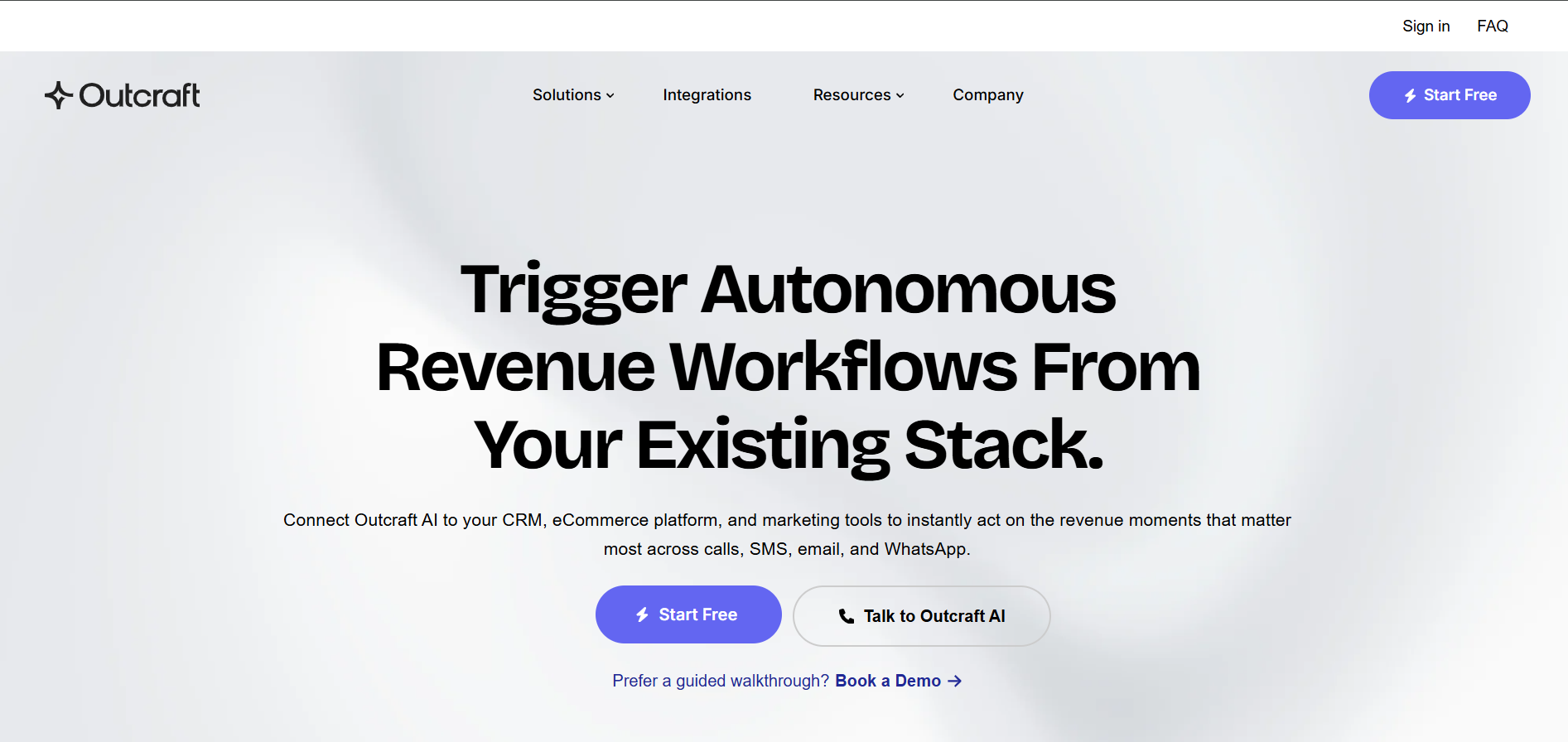
This functional limitation separates true autonomous infrastructure like Outcraft AI from standalone conversational voice bots like Bland, Synthflow, or Retell. Rather than executing isolated scripts, Outcraft AI handles the complete lifecycle of incoming demand.
The system ingests the inbound data, parses the unique intent against internal business repositories, selects the optimal channel path, and initiates tailored outreach across text, email, or voice.
It can even orchestrate real-time calendar synchronization to lock in meetings with prospects during a live conversation.
Outcraft AI HubSpot integration is perfect for such a scenario, which drastically speeds up the scheduling process by automatically cross-referencing team availability and generating booking links on the fly without a rep in the loop.
The Anatomy of Real-Time Data Activation
Acting on leads within minutes may sound like a conjecture and a pipe dream, but looking more closely at automated platforms like Outcraft AI reveals exactly how an integrated operational layer activates an inbound lead within a two-minute window.
The process begins with immediate ingestion and database sync. The engine reads the incoming web form submission, verifies if the contact or target enterprise already exists in the central CRM, appends missing firmographic fields, and updates the record instantly.
Next, the system bypasses traditional lead scoring buckets to conduct an immediate intent analysis. It reads the raw text of the inquiry and references the exact sequence of website pages the prospect browsed prior to submission.
Finally, the system handles multi-channel delivery through the designated account representative’s actual inbox or messaging profile.
If the interaction scales to a live voice engagement, the system automatically routes the active prospect to an available human sales representative, maintaining velocity when intent is highest.
Native CRM Integration Protects the Pipeline: Here’s How
An execution engine is only as effective as the data parameters it is permitted to read. Siloed tools cannot safely make operational decisions on behalf of an organization because true speed-to-lead automation requires deep, two-way understanding with the central revenue database that no traditional toolkit can replicate.
Direct infrastructure integration protects active pipeline data in three specific ways:
- Deal Interception Prevention: The engine constantly tracks open opportunities, ensuring automated workflows never trigger on accounts currently engaged in active negotiations with an account executive.
- Auditability: Every single data analysis, draft variant, and outgoing communication logs directly to the contact timeline, providing revenue operations managers with total visibility to audit and optimize performance parameters.
- Automated Routing Security: When a new lead from an enterprise tier account enters the system, the platform instantly identifies the matching parent organization and assigns the task to the existing account owner.
All this, at least in the case of Outcraft AI, while featuring native integration with dozens of systems like HubSpot, Shopify, WhatsApp or Slack, and handling refunds, cancellations, and inbound product questions in real time.
Inbound Operational Scale Reimagined
This deep database integration is what makes hitting modern inbound timing benchmarks operationally possible.
Because in the modern sales climate, speed is the most important currency. Landmark data published in the Harvard Business Review highlights that organizations attempting to contact potential customers within an hour of receiving an inquiry are nearly seven times more likely to hold a qualifying conversation than teams that let 60 minutes slip away.
Making a transition to automatic background layers flips the sales funnel script. It no longer matters if a website captures 10 leads a week or 10,000; the autonomous execution guarantees that incoming inquiries receive immediate attention and rapid routing without administrative delay.
This frees up teams to stop acting as data monitors and allows them to shift their focus entirely to managing active, qualified customer relationships rather than getting bogged down answering emails.
