

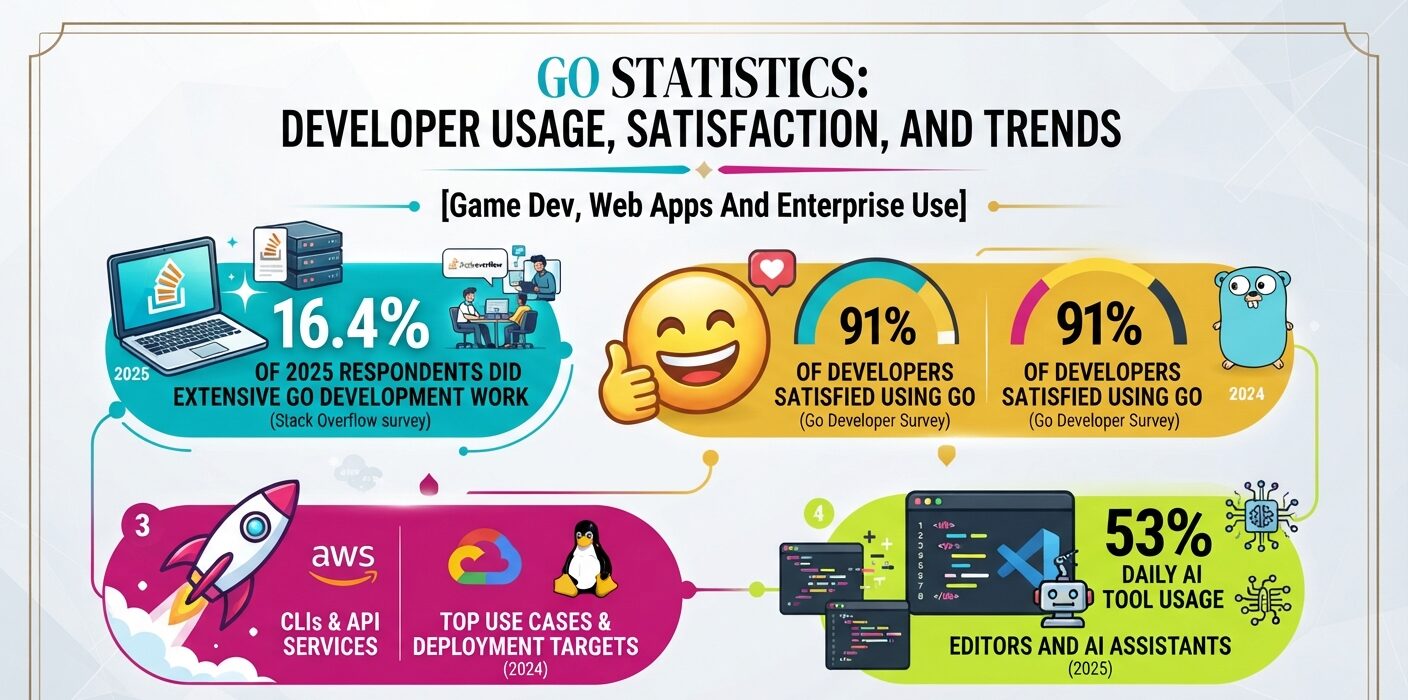
Go sits 12th on the TIOBE index for September 2026 at a 1.10% rating, while 91% of respondents to the Go team’s 2025 survey said they felt satisfied using it. The two numbers measure different things. This page sets out Go statistics from four primary datasets, covering developer usage, satisfaction, workloads, release performance and the statistics packages Go developers import.
Go Statistics
- 16.4%of 2025 Stack Overflow respondents did extensive development work in Go
- 91%of 2025 Go Developer Survey respondents felt satisfied using Go
- 12thGo’s TIOBE rank in September 2026, down from 8th a year earlier
- 13%of Go survey respondents had used Go for under a year in 2025, down from 21% in 2024
- 1,310packages import montanaflynn/stats on pkg.go.dev, the top Go statistics library by importers
How Many Developers Use Go in 2026?
Go reached 16.4% of all respondents in Stack Overflow’s 2025 Developer Survey. The question counts people who did extensive development work in a language over the past year, and respondents are self-selected.
That share ranks Go 13th, behind PHP at 18.9% and ahead of Rust at 14.8%. JavaScript tops the same list at 66%, as detailed in these JavaScript usage figures.
| Respondent group | Did extensive Go work | Responses to question |
|---|---|---|
| All respondents | 16.4% | 31,771 |
| Professional developers | 17.4% | 24,759 |
| Learning to code | 13.1% | 2,564 |
| Professionals that use AI | 18.1% | 20,810 |
| Learners that use AI | 12.3% | 1,945 |
Source: Stack Overflow Developer Survey, 2025 edition
Professionals report more Go work than learners, 17.4% against 13.1%. Among learners, Python’s survey share reaches 71.8%.
Go Admired and Desired Scores, 2025
56.5% of developers who used Go in the past year want to keep using it, Stack Overflow’s “admired” measure. The “desired” share, respondents who want to work with Go next year, sits at 23.4%.
Rust leads the admired list at 72.4%. C# lands close to Go at 55.8% admired and 19.4% desired, and its wider numbers appear in these C# statistics.
Source: Stack Overflow Developer Survey, 2025 edition, 31,771 responses to the language question
2025 Go Developer Survey Statistics: Who Writes Go
| Respondent characteristic | Share of respondents |
|---|---|
| Professional developers | 87% |
| Use Go for their primary job | 82% |
| Use Go for personal or open-source projects | 72% |
| Six or more years of professional experience | 75% |
| Aged 25 to 45 | 68% |
| Work in the Technology industry | 46% |
| Work at organizations of over 1,000 employees | 30% |
Source: Go Developer Survey 2025, fielded 9–30 September 2025, 5,379 responses after cleaning
The Go team received 7,070 responses and kept 5,379 after removing bots and low-quality entries. Invitations ran through the Go blog, social channels and randomized prompts in VS Code and GoLand, so the sample is self-selected.
Over 80% of respondents learned Go after starting their professional career. Each row above comes from a separate question, so the shares do not sum.
Go Satisfaction Rate: 91% in 2025
91% of respondents felt satisfied working with Go, and 62% picked “very satisfied.” The Go team reports the metric has held steady since it first asked the question in 2019.
Sentiment toward the Go project itself scored lower. The team lists contributor growth and trust in Go leadership as focus areas for 2026.
Source: Go Developer Survey 2025, September 2025
Newcomers Fell to 13%
13% of 2025 respondents had used Go for less than a year, down from 21% in 2024. The Go team suspects a link to industry-wide declines in entry-level software roles and presents it as a hypothesis.
Source: Go Developer Survey 2025, with 2024 comparison published in the same report
What Do Developers Build With Go?
CLIs and API services remain the top use cases, and 55% of respondents build both. Over one third build cloud infrastructure tooling, and 11% work with ML models, tools or agents.
96% deploy to Linux-based systems, including containers. Server-side context sits in these Linux market share statistics.
Embedded devices and IoT rose from 2% to 8% of respondents. The Go team calls it the only meaningful deployment platform change since 2024.
AWS leads work deployment targets at 46%, ahead of company-owned servers at 44% and Google Cloud Platform at 26%. The question allowed several answers, so shares overlap.
Source: Go Developer Survey 2025, September 2025, multi-select question
60% of respondents write Go on macOS and 58% on Linux, and could pick both. Stack Overflow’s wider pool is split out in this developer OS preference breakdown.
78% are not building AI-powered features into their Go software, and 66% say it uses no AI at all. In 2024, 59% were not involved in AI feature work.
Source: Go Developer Survey 2025, September 2025
53% Use AI Tools Daily: Editors and Assistants Among Go Developers
VS Code is the favorite Go editor for 37% of respondents and GoLand for 28%. Zed and Cursor each reach 4%. These shares exclude respondents referred to the survey from VS Code or GoLand.
| AI tool metric | Share of respondents |
|---|---|
| Use AI-powered tools daily when writing Go | 53% |
| Used them not at all, or only a few times last month | 29% |
| Use agentic mode as their primary approach | 17% |
| Satisfied with AI-powered tools | 55% |
| Named non-functional code as the main problem | 53% |
Source: Go Developer Survey 2025, September 2025
AI tool satisfaction splits into 42% “somewhat satisfied” and 13% “very satisfied.” Cross-language adoption data appears in these vibe coding statistics.
TIOBE Ranks Go 12th in September 2026
| Sep 2026 | Sep 2025 | Language | Rating | Change |
|---|---|---|---|---|
| 8 | 11 | SQL | 2.16% | +0.29% |
| 9 | 13 | R | 1.69% | +0.27% |
| 10 | 18 | Rust | 1.34% | +0.33% |
| 11 | 12 | Fortran | 1.24% | -0.25% |
| 12 | 8 | Go | 1.10% | -1.22% |
| 13 | 9 | Delphi/Object Pascal | 1.08% | -1.18% |
| 14 | 15 | PHP | 1.04% | -0.21% |
Source: TIOBE Index, September 2026
Go dropped four places in twelve months, from 8th to 12th, as its rating fell 1.22 points. Rust moved the other way, from 18th to 10th.
TIOBE bases ratings on skilled engineers, courses and third-party vendors, counted through Google, Amazon, Wikipedia, Bing and more than 20 other sites. It states the index does not measure the best language or lines of code written.
Go won TIOBE’s Programming Language of the Year in 2009 and 2016. Survey and search rankings often split, as these most used programming language rankings show.
PHP sits two places below Go at 1.04%, and its live-site footprint is tracked in these PHP usage numbers.
Release-by-Release Go Statistics: 1.26 and 1.27
Go 1.27 arrived six months after Go 1.26, per its release notes. Both releases published measured runtime changes.
| Release | Date | Documented change |
|---|---|---|
| Go 1.26 | 10 February 2026 | Green Tea garbage collector on by default; expected 10–40% lower GC overhead in programs that use the GC heavily |
| Go 1.26 | 10 February 2026 | Baseline cgo call overhead down about 30% |
| Go 1.27 | 19 August 2026 | Small-object (under 80 bytes) allocation cost down by up to 30%; about 1% overall for allocation-heavy programs |
| Go 1.27 | 19 August 2026 | Generic methods, encoding/json/v2, uuid package, post-quantum crypto/mldsa |
Source: Go 1.26 release notes and Go 1.27 release announcement, go.dev, 2026
The Go team expects about 10% further GC overhead savings on newer amd64 CPUs, Intel Ice Lake or AMD Zen 4 and later. None of these figures is a whole-program speedup.
Which Go Statistics Library Has the Most Importers?
| Package | Imported by | Latest version | Published | License |
|---|---|---|---|---|
| github.com/montanaflynn/stats | 1,310 | v0.12.4 | 17 Aug 2026 | MIT |
| gonum.org/v1/gonum/stat | 883 | v0.17.0 | 29 Dec 2025 | BSD-3-Clause |
Source: pkg.go.dev, counts read 29 September 2026
montanaflynn/stats leads with 1,310 importing packages against 883 for Gonum’s stat package. Its README describes it as a statistics library with no dependencies.
Gonum’s stat package ties into the wider Gonum module, and functions such as CorrelationMatrix take Gonum matrix types. Version 0.17.0 added Wasserstein distance functions.
26% of 2025 Go Developer Survey respondents listed finding trustworthy Go modules among their top three frustrations.
Source: Go Developer Survey 2025, September 2025
FAQs
Is Go still popular in 2026?
By survey measures, yes. 16.4% of Stack Overflow’s 2025 respondents did extensive Go work, and 91% of 2025 Go Developer Survey respondents felt satisfied. TIOBE ranked Go 12th in September 2026.
Why do Reddit threads say Go is dying?
Most cite TIOBE, where Go fell from 8th to 12th between September 2025 and September 2026. TIOBE tracks search-based signals. Stack Overflow’s 2025 survey still shows 17.4% of professional developers using Go.
What is Go mainly used for?
CLIs and API services. In the 2025 Go Developer Survey, 55% built both, over a third built cloud infrastructure tooling, and 96% deployed to Linux-based systems, including containers.
How many developers use Go?
No primary source counts every Go user. Stack Overflow’s 2025 survey found 16.4% of 31,771 respondents did extensive Go work. The Go team’s 2025 survey used 5,379 cleaned responses.
Is Go good for statistics and data analysis?
Working packages exist, but the ecosystem is small. On pkg.go.dev, montanaflynn/stats had 1,310 importers and Gonum’s stat package 883 as of 29 September 2026.
References
https://go.dev/blog/survey2025
https://survey.stackoverflow.co/2025/technology
https://www.tiobe.com/tiobe-index/
https://commandlinux.com/statistics/go-programming-language-usage
