

Running experiments on your website without a reliable experimentation platform feels like navigating blindfolded.
Every button color, headline tweak, or checkout layout carries revenue implications, and guessing simply costs too much.
The right tool transforms raw traffic into actionable insights, letting you validate ideas before committing resources.
But the landscape has shifted dramatically. AI agents now generate test variants, predictive scoring ranks hypotheses before you even launch, and privacy regulations demand full data ownership.
Choosing between platforms means weighing statistical rigor against ease of use, integration depth against pricing flexibility, and speed against compliance.
This guide breaks down six leading experimentation platforms across real capabilities, concrete data points, and honest trade-offs.
Whether you manage a lean startup or a global e-commerce operation, you’ll find a clear picture of what each tool actually delivers.
Matomo
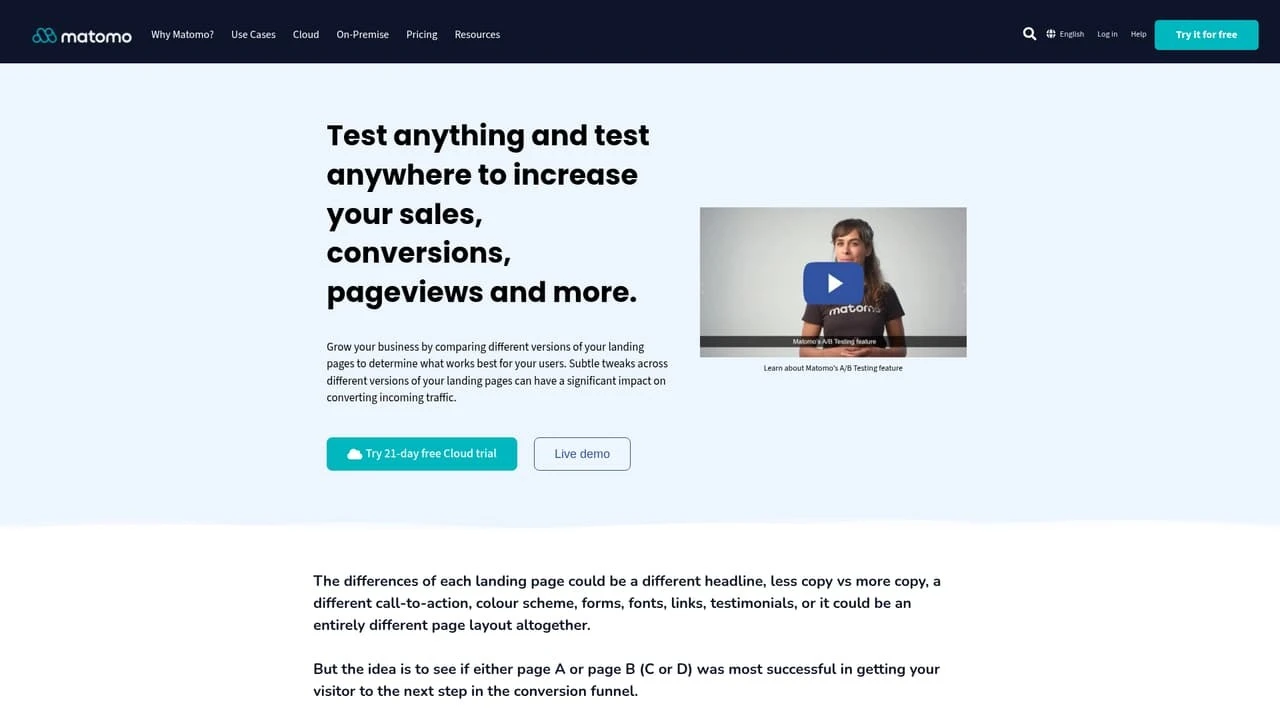
Matomo combines web analytics and conversion rate optimization in a single self-hosted or cloud platform. Unlike tools that bolt testing onto a separate analytics suite, it merges visitor profiles with experiment data, giving you the complete user journey from first click to conversion.
The A/B testing module supports multivariate experiments across pages A, B, C, or even D simultaneously. You can test headlines, CTA buttons, layouts, color schemes, forms, fonts, links, and testimonials without restriction. There’s no cap on the number of concurrent experiments you run.
Goal tracking goes beyond simple click counts. You define measurable objectives like sales, revenue, page views, time on site, or bounce rate reduction, then watch results flow into the same dashboard where you analyze all your traffic. That unified view eliminates the friction of switching between separate tools.
Full data ownership sets Matomo apart. Your collected data stays on your servers (or Matomo’s cloud with no third-party sharing), which simplifies compliance with GDPR, CCPA, and other privacy regulations. Organizations in healthcare, finance, or government often need exactly this level of control.
Audience segmentation ties directly into visitor profiles. You can pull up the complete interaction history of any user who entered a test, trace their path across sessions, and understand why a variant won or lost. A 21-day free trial lets you validate the setup before committing.
Optimizely
Optimizely positions itself as an AI-powered experience platform trusted by over 10,000 brands worldwide. Its architecture rests on three pillars: Agentic CMS for rapid content publishing, Agentic Experimentation for continuous testing, and Agent Platform for workflow automation.
The numbers from enterprise clients speak volumes. The Royal Mint reported a 50% conversion lift after deploying the platform.
Travis Johnson, Director of Product Analytics, highlighted over 400 hours saved through automated experiment management. And L’Oréal’s Luxe Division, led by Kelly Jenkins, now runs 200+ experiments per year at scale.
What makes it attractive for large teams? Creative marketers and product managers offload repetitive administrative tasks to the AI layer. That means fewer bottlenecks, faster iteration cycles, and the ability to scale experimentation without hiring additional analysts.
The platform also integrates with your existing tool stack, from CRMs to data warehouses. A dedicated LLM monitoring capability stands out for teams building AI-powered products, letting you test and optimize language model outputs alongside traditional web experiments.
This dual capability appeals to forward-thinking product organizations pushing into generative AI territory.
Kameleoon
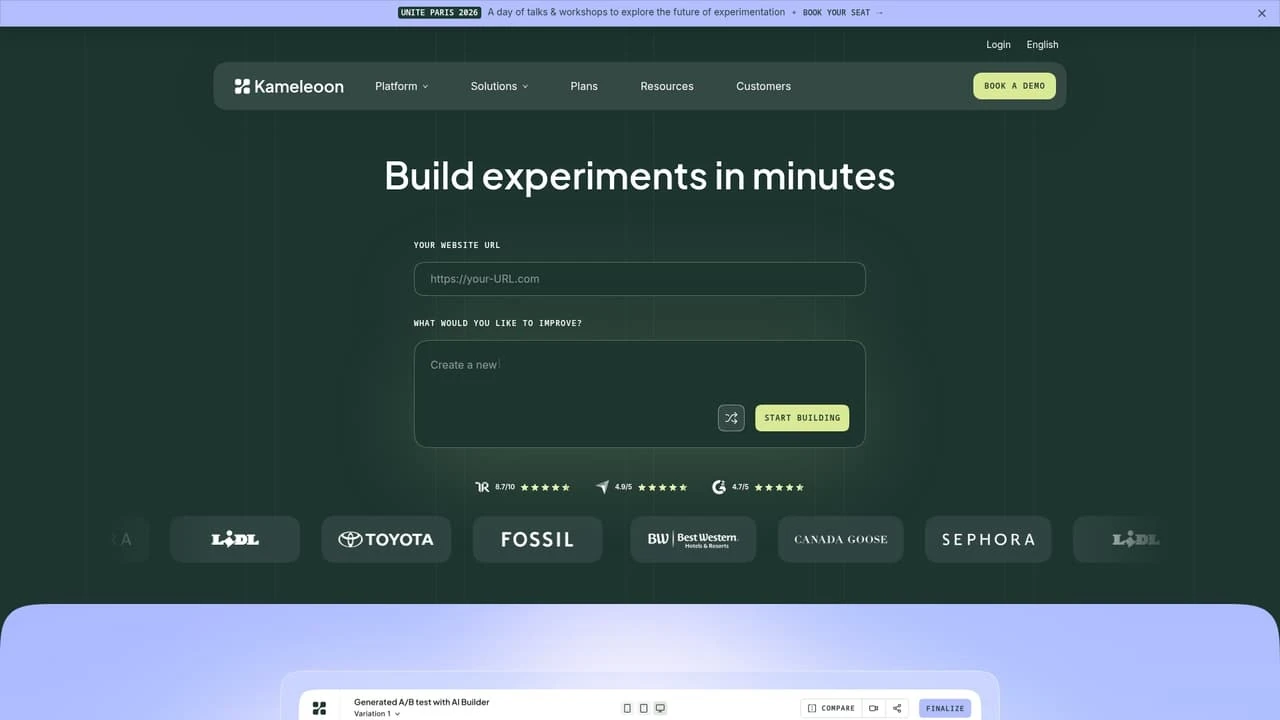
Kameleoon’s conversational AI approach lets you build experiments in minutes by simply describing what you want to test.
The platform’s agent generates production-ready variants, while a visual editor and full code access keep both marketers and developers comfortable. You create banners, pop-ups, and forms without touching a single line of code, or you dive into the source whenever you need granular control.
Performance obsession defines the technical architecture. The snippet weighs just 28.4KB, CDN latency stays below 50ms, and the rendering pipeline eliminates flickering entirely.
For single-page applications built with React or Next.js, Kameleoon provides native compatibility that many competitors still handle awkwardly.
- Predictive Impact Scoring ranks test hypotheses using patterns from thousands of past experiments
- Real-time SRM detection flags Sample Ratio Mismatch automatically so you never act on skewed data
- Conversion drop alerts notify your team the moment a variant starts hurting performance
- Custom attribution windows adapt to your specific sales cycle length
Privacy certifications stack up too: ISO 27001, SOC2, plus GDPR and CCPA compliance alongside HIPAA support for healthcare use cases.
The platform also bypasses Safari ITP protections and ad blocker interference, ensuring you capture traffic data that other tools miss. A multi-step validation system adds guardrails for critical production changes.
AB Tasty
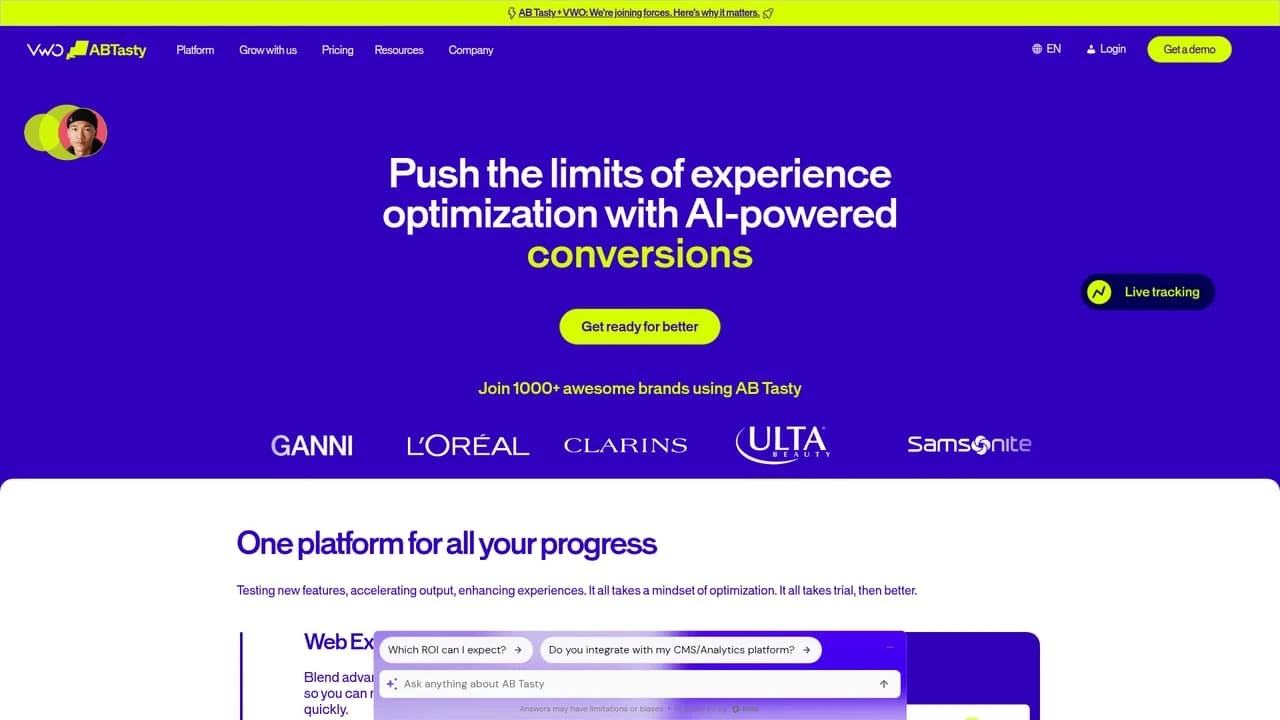
AB Tasty blends advanced experimentation with approachable experience building under one roof. The platform covers web experimentation, feature experimentation, personalization, e-merchandising, rollouts, and AI capabilities, all accessible through a unified interface backed by 13 years of optimization expertise.
Evi, the platform’s AI agent, deserves particular attention. Unlike generic copilots, Evi operates as an evidence-based marketing assistant that transforms complex datasets into clear strategies.
It supports every phase of the workflow: hypothesis generation, test design, and post-experiment reporting. Think of it as a junior analyst who never sleeps and never cherry-picks favorable metrics.
The Visual Editor accepts prompt-based instructions. Want to update button colors, add scroll animations, or swap hero images?
Describe the change in plain language and the editor produces it. This removes the traditional back-and-forth with engineering for simple front-end modifications.
AdaptiveCX tackles a problem most platforms ignore: the 90% of anonymous visitors who arrive without any identifiable profile.
Using real-time predictive AI, it identifies behavioral signals and personalizes the experience on the fly. For e-commerce sites with heavy anonymous traffic, this feature directly impacts revenue per session.
An extensive partner and integrations network rounds out the offering, letting teams plug AB Tasty into existing workflows without rearchitecting their tech stack.
Statsig
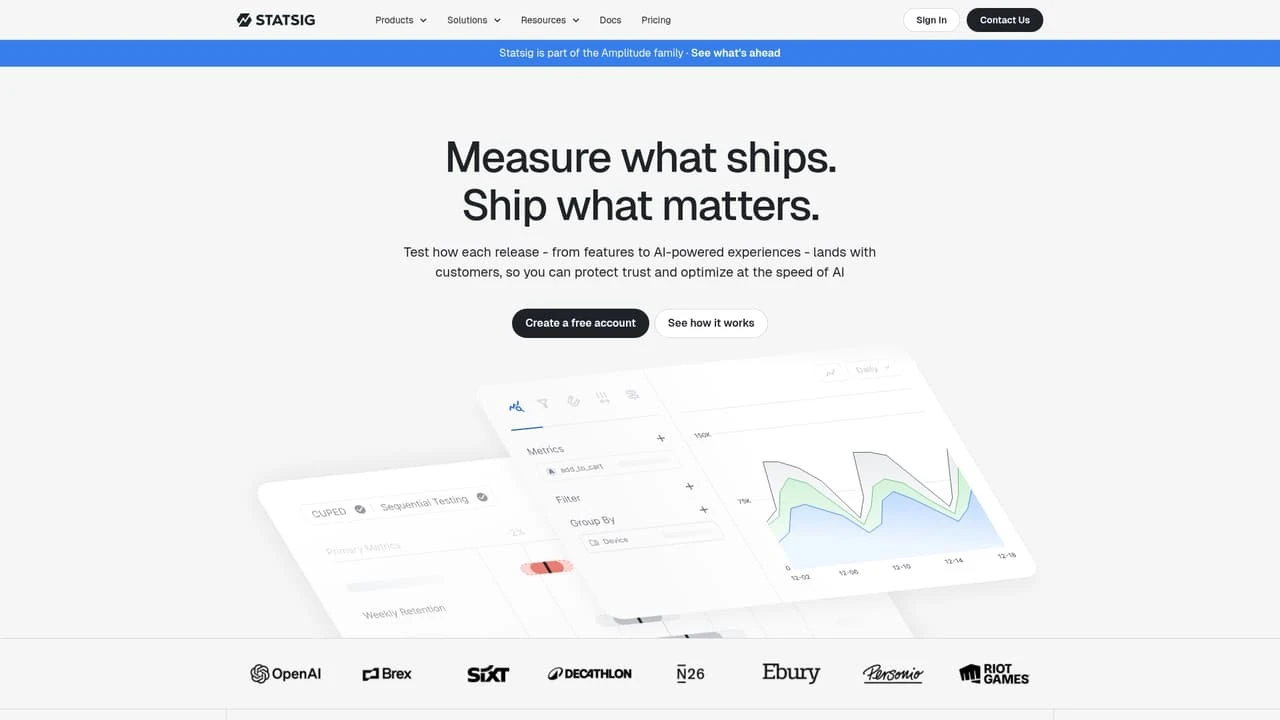
Statsig packs five distinct products into a single platform: experimentation, feature management, product analytics, session replays, and metrics. Companies like OpenAI, Brex, Notion, and Ancestry rely on it daily, which signals serious enterprise-grade reliability.
The infrastructure processes over 100 billion events per day. That scale matters when you need to slice test results across dozens of dimensions without waiting for batch jobs.
Product managers set up experiments through a self-service interface that requires no pre-work from data engineering, and automated analysis surfaces statistically significant results without manual intervention.
How does collaboration actually work in practice? Feature flags link directly to product data, so every deploy connects to measurable outcomes.
Session replays attach to specific flags and experiments, letting you watch exactly how users interact with each variant. When something breaks, a dedicated Slack integration routes alerts to the right team instantly.
The pricing model starts with a generous free tier, scaling into enterprise plans as event volume grows. This approach lets small teams validate the platform before committing budget, a rarity among tools that gate core features behind sales calls.
Statsig’s world-class statistics engine applies advanced treatments automatically, which removes the need for in-house statisticians to verify every experiment result.
VWO
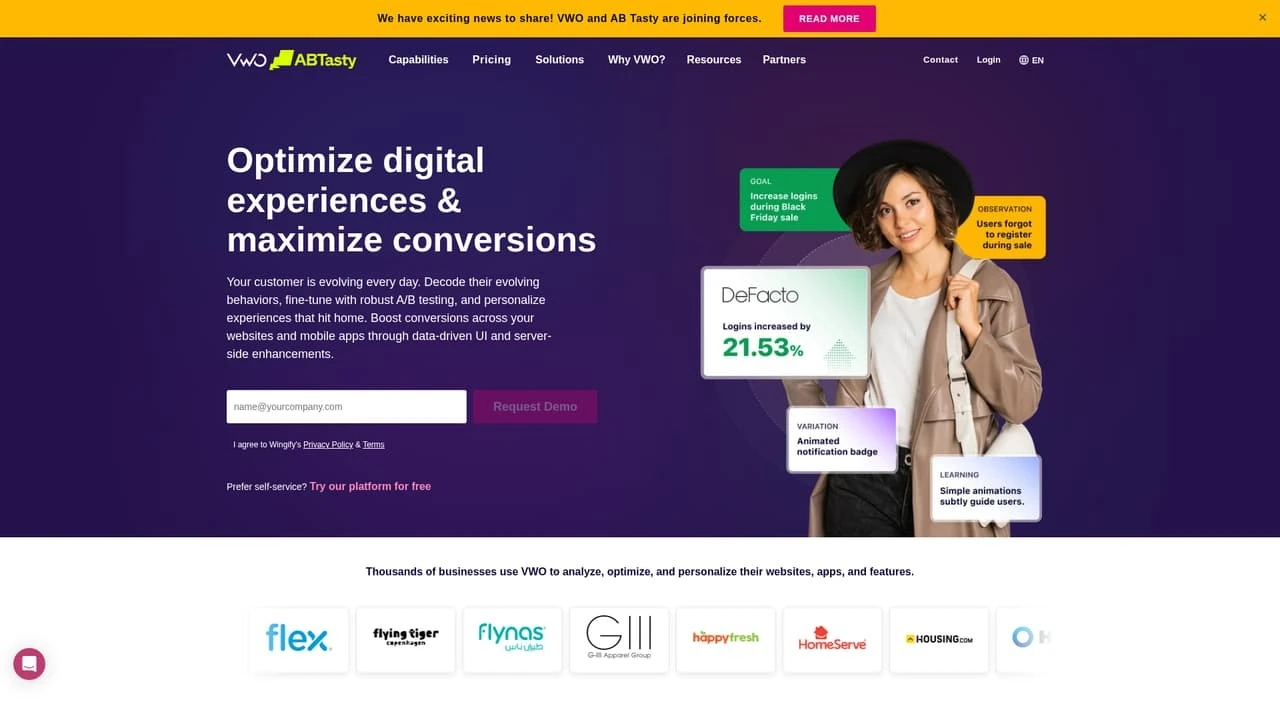
VWO delivers a full experimentation suite covering both web and mobile apps, with no limits on variations, user accounts, metrics, or session recordings. Its Bayesian statistical engine produces real-time reports that update as data flows in, rather than forcing you to wait for fixed sample sizes.
The behavioral analysis layer goes deeper than most competitors. Heatmaps and session recordings integrate directly into test reports, alongside funnels, form analytics, and surveys.
VWO detects rage clicks and dead clicks automatically, surfacing friction points you might never spot through quantitative data alone. This qualitative lens adds context that pure numbers can’t provide.
Wandz, the platform’s agentic optimization system, automates three traditionally manual steps:
- Behavioral analysis of visitor segments
- Hypothesis generation based on detected patterns
- Workflow orchestration from insight to live experiment
For non-technical users, the no-code visual editor handles test creation without engineering support. You build variants through drag-and-drop, preview changes, and launch experiments in minutes.
Setup requires minimal configuration, and the interface presents results in language that non-specialist stakeholders understand immediately.
Hosting on Google Cloud Platform keeps Total Blocking Time impact minimal, and the infrastructure handles billions of daily requests with 100% uptime as the stated target.
Support runs 24/7, with a direct contact line at +1 (844) 822 8378 for onboarding and end-to-end consultation. SDKs in 8+ programming languages and integrations with GA4 and Mixpanel round out a platform built for teams that want depth without complexity.
