

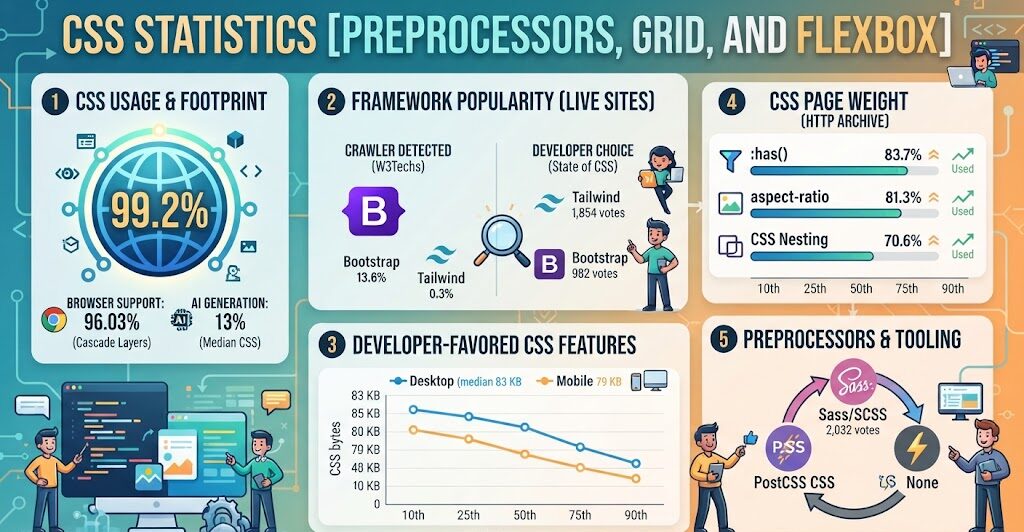
CSS runs on 99.2% of all websites W3Techs surveyed on 10 September 2026, a wider footprint than any server-side language or framework. The numbers below come from four datasets that each count something different: a crawler survey of live sites, an opt-in developer survey, browser support weighted by traffic share, and an annual crawl of page bytes. The gaps between them carry most of the story.
CSS Statistics
How Many Websites Use CSS?
W3Techs fingerprints public pages and splits CSS into three delivery methods. A site can use all three, so the rows overlap and cannot be added together.
Inline styles edge out linked stylesheets by a full percentage point. Page builders and CMS templates write style attributes directly into markup, which keeps that number high regardless of what hand-written stylesheets do. The same crawler shows how JavaScript is deployed across live sites, where the deployed-versus-current gap is even wider.
| Delivery method | Share of all websites |
|---|---|
| Any CSS | 99.2% |
| Inline CSS (style attributes) | 93.6% |
| External CSS (linked files) | 92.6% |
| Embedded CSS (style blocks) | 83.7% |
Source: W3Techs, usage statistics of CSS for websites, 8–10 September 2026. Shares are of all surveyed websites; one site may use more than one method.
CSS Framework Statistics: Crawlers Versus Developers
W3Techs reports that 81.9% of websites use none of the CSS frameworks it monitors. Bootstrap leads the rest at 13.6% of all sites, which the survey converts to a 74.8% share of the framework-using segment.
| Framework | Share of all websites | Share of framework-using sites |
|---|---|---|
| None detected | 81.9% | — |
| Bootstrap | 13.6% | 74.8% |
| Animate | 7.6% | 42.0% |
| Foundation | 0.4% | 2.3% |
| Tailwind | 0.3% | 1.7% |
| UIkit | 0.2% | 0.9% |
Source: W3Techs, usage statistics and market share of CSS frameworks, 9 September 2026. A website may use more than one framework, so rows overlap.
The State of CSS 2026 survey asks a different question of a different population and returns a near-inverted ranking. Tailwind CSS was the most picked answer, chosen by 1,854 of the 3,697 people who answered the framework question.
Neither column is wrong. W3Techs detects code already shipping, and Bootstrap leaves obvious traces in class names and CDN URLs. Tailwind compiles into a project-specific stylesheet with no stable signature, so a crawler has little to match against. The same deployed-versus-recent split shows up in PHP version deployment data.
| Framework | Respondents selecting it |
|---|---|
| Tailwind CSS | 1,854 |
| None | 1,042 |
| Bootstrap | 982 |
| shadcn/ui | 802 |
| Custom/in-house framework | 705 |
| Material UI | 692 |
| Bulma | 145 |
Source: State of CSS 2026, CSS frameworks question, n = 3,697 of 5,506 developers reached. Opt-in survey, responses collected 19 May to 27 June 2026. Multiple selections allowed, so counts overlap and cannot be summed.
Which CSS Features Do Developers Use?
The survey sorts each feature into three exclusive buckets: used it, heard of it, never heard of it. :has() and aspect-ratio top the used list, and CSS Nesting sits third at 70.6%.
Anchor positioning posted the largest year-over-year usage increase of any tracked feature at 15 percentage points, according to Devographics. It also ranked first as the favorite new feature respondents started using this year.
| Feature | Used it | Heard of it | Never heard of it |
|---|---|---|---|
| :has() | 83.7% | 12.3% | 3.8% |
| aspect-ratio | 81.3% | 12.3% | 5.9% |
| CSS Nesting | 70.6% | 23.8% | 5.1% |
| scroll-behavior | 68.2% | 18.3% | 12.7% |
| Viewport-relative units | 59.8% | 24.7% | 15.0% |
Source: State of CSS 2026, all features question. Percentages are of question respondents, opt-in survey, May–June 2026.
CSS Browser Support Statistics By Feature
Can I Use weights browser support by StatCounter’s global usage share for August 2026, so these figures describe sampled pageviews rather than developers or sites. Cascade layers reach 96.03% on that basis.
Anchor positioning is the outlier, and its headline number is soft: 57.74% of that 85.93% is full support and 28.19% is partial. CSS Nesting splits the same way, with 91.8% full and 1.83% partial.
| Feature | Full support | Partial | Total usage share |
|---|---|---|---|
| Cascade layers | 96.03% | 0% | 96.03% |
| :has() | 94.82% | 0% | 94.82% |
| CSS Nesting | 91.80% | 1.83% | 93.63% |
| Subgrid | 93.48% | 0% | 93.48% |
| Anchor positioning | 57.74% | 28.19% | 85.93% |
Source: Can I Use, feature support tables, accessed 10 September 2026. Usage share statistics by StatCounter GlobalStats for August 2026.
Availability now runs ahead of reported use for most of this list. Nesting is supported for 93.63% of tracked usage while 70.6% of surveyed developers report having used it.
CSS Page Weight Statistics From The HTTP Archive Crawl
The 2025 Web Almanac, published 15 January 2026 from a July 2025 crawl, measures transferred CSS bytes per page. The median desktop page carries 83 KB against 79 KB on mobile.
Growth is modest next to other resource types. At the median, CSS grew 4 KB year over year, which the chapter authors describe as roughly 4,000 additional characters. At the 90th percentile it added 8 KB. The four-kilobyte desktop-mobile gap means sites ship near-identical stylesheets to both, which matters given how much of global web traffic is now mobile.
| Percentile | Desktop | Mobile |
|---|---|---|
| 10th | 10 KB | 7 KB |
| 25th | 38 KB | 34 KB |
| 50th (median) | 83 KB | 79 KB |
| 75th | 161 KB | 156 KB |
| 90th | 274 KB | 268 KB |
Source: HTTP Archive Web Almanac 2025, Page Weight chapter, Figure 14.26, July 2025 crawl.
CSS Requests And Minification
The median page made 8 CSS requests on both desktop and mobile. At the 90th percentile that climbed to 31 on desktop and 30 on mobile, up from 26 on both in the 2024 edition.
Minification slipped. 61% of desktop and 62% of mobile home page loads passed Lighthouse’s Minify CSS audit, each down one point against 2024. Server-side context for these crawls sits in the web server operating system breakdown.
CSS Preprocessor Statistics And Tooling
Sass and SCSS remain the most selected preprocessor answer at 2,032 of 3,656 respondents, ahead of PostCSS at 1,284. Devographics describes preprocessor use overall as declining.
CSS-in-JS has moved further. “None” was the top answer on that question at 2,073 of 3,489 respondents, ahead of CSS Modules at 922 and Styled Components at 753. Lightning CSS is the newer entry at 373. Tooling consolidation of this kind also shows up in version control and developer tooling adoption.
| Pre-/post-processor | Respondents selecting it |
|---|---|
| Sass/SCSS | 2,032 |
| PostCSS | 1,284 |
| None | 912 |
| Lightning CSS | 373 |
| Less | 297 |
| Stylus | 57 |
Source: State of CSS 2026, pre-/post-processors question, n = 3,656. Multiple selections allowed; counts overlap.
How Much CSS Is AI-Generated?
The median respondent reported that 13% of the CSS they produce is AI-generated. 26% reported generating none of it that way, the single largest bucket on the question.
Devographics notes this chart looks nothing like the equivalent question in its State of AI or State of JS surveys, and points to comments saying AI handles CSS poorly. The survey is opt-in, so it describes its respondents rather than developers generally.
CSS Developer Statistics
The respondent pool skews experienced. Median age is 37 across 3,473 answers and median experience is 14 years across 3,645. Of 3,589 people answering the education question, 1,921 hold a degree in a related field, 882 hold none and 786 hold one in an unrelated field.
Happiness with CSS averaged 4 on a 5-point scale across 3,747 responses, against 3.8 for web technologies generally. Platform choices among this group track with wider developer operating system preference data.
FAQs
What percentage of websites use CSS in 2026?
99.2% of all websites W3Techs surveyed on 10 September 2026 use CSS. Inline styles appear on 93.6% of sites, external stylesheets on 92.6% and embedded style blocks on 83.7%.
Why do Reddit threads say Tailwind won when W3Techs shows Bootstrap ahead?
The two count different things. W3Techs detects shipped code and found Bootstrap on 13.6% of sites against Tailwind’s 0.3%. Tailwind compiles to project-specific output crawlers cannot fingerprint.
How much CSS does a typical page ship?
83 KB on the median desktop page and 79 KB on mobile, across 8 CSS requests on both, per the 2025 Web Almanac July 2025 crawl. The 90th percentile carries 274 KB on desktop.
Do Reddit claims that Sass is finished match the survey data?
Not yet. Sass/SCSS was still the top preprocessor answer in State of CSS 2026, picked by 2,032 of 3,656 respondents. Devographics does describe preprocessor use overall as declining.
How much CSS is AI-generated?
The median State of CSS 2026 respondent reported 13% of their CSS as AI-generated. 26% reported none at all. The survey is opt-in and describes its respondents, not all developers.
Sources
https://w3techs.com/technologies/details/ce-css
https://2026.stateofcss.com/en-US/
https://caniuse.com/
https://almanac.httparchive.org/en/2025/page-weight
